
Pumpkin Investigation.
Pumpkin Investigation.
Quick Answer
Pumpkin Investigation is a hands-on preschool science resource for ages 3–5. Pair real pumpkins with picture references, vocabulary cards, and activity signs to help children observe, compare, measure, make predictions, and explore during free-choice centers.
Description
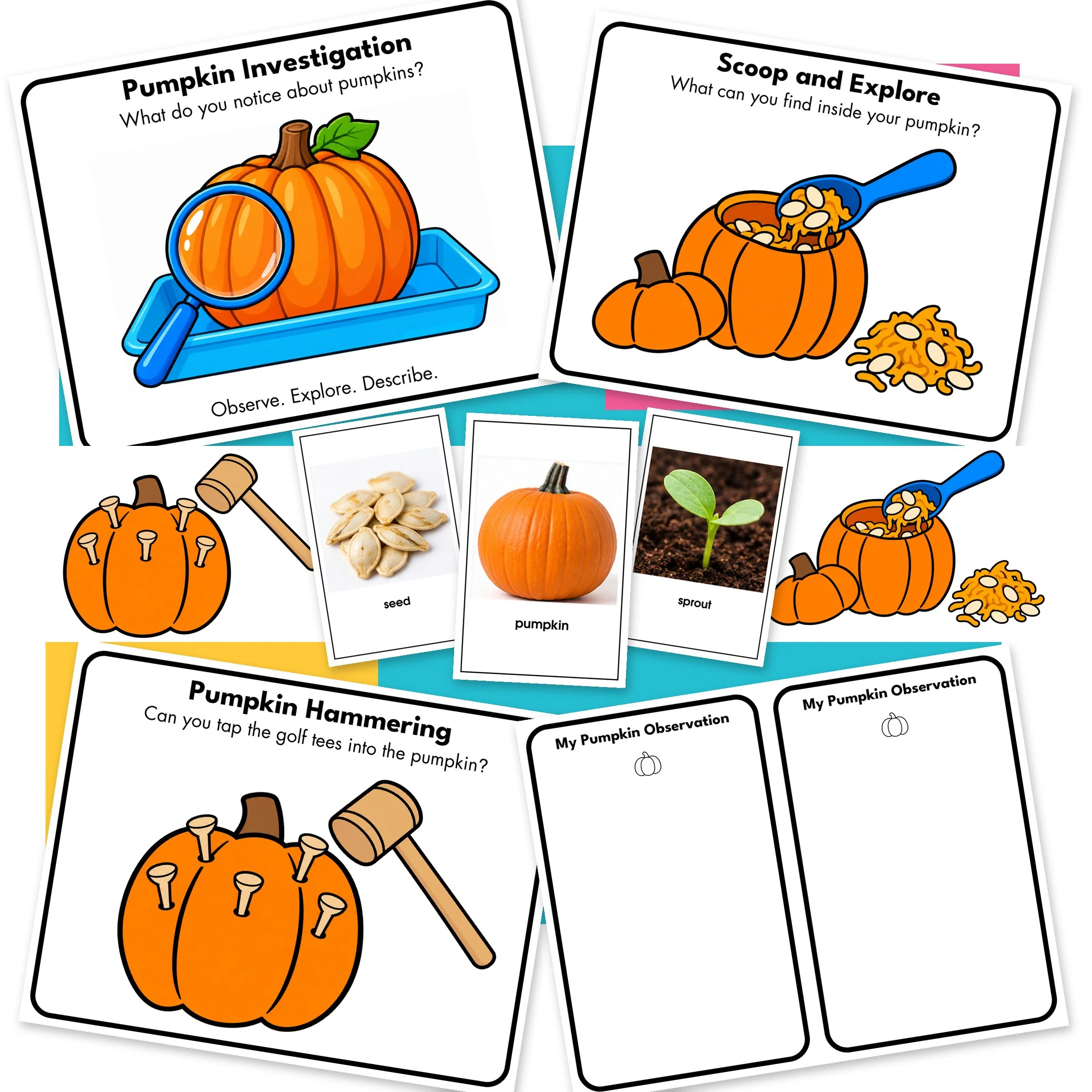
Pumpkin Investigation gives you the printable materials to create an interactive pumpkin science center where children can explore real pumpkins in different ways.
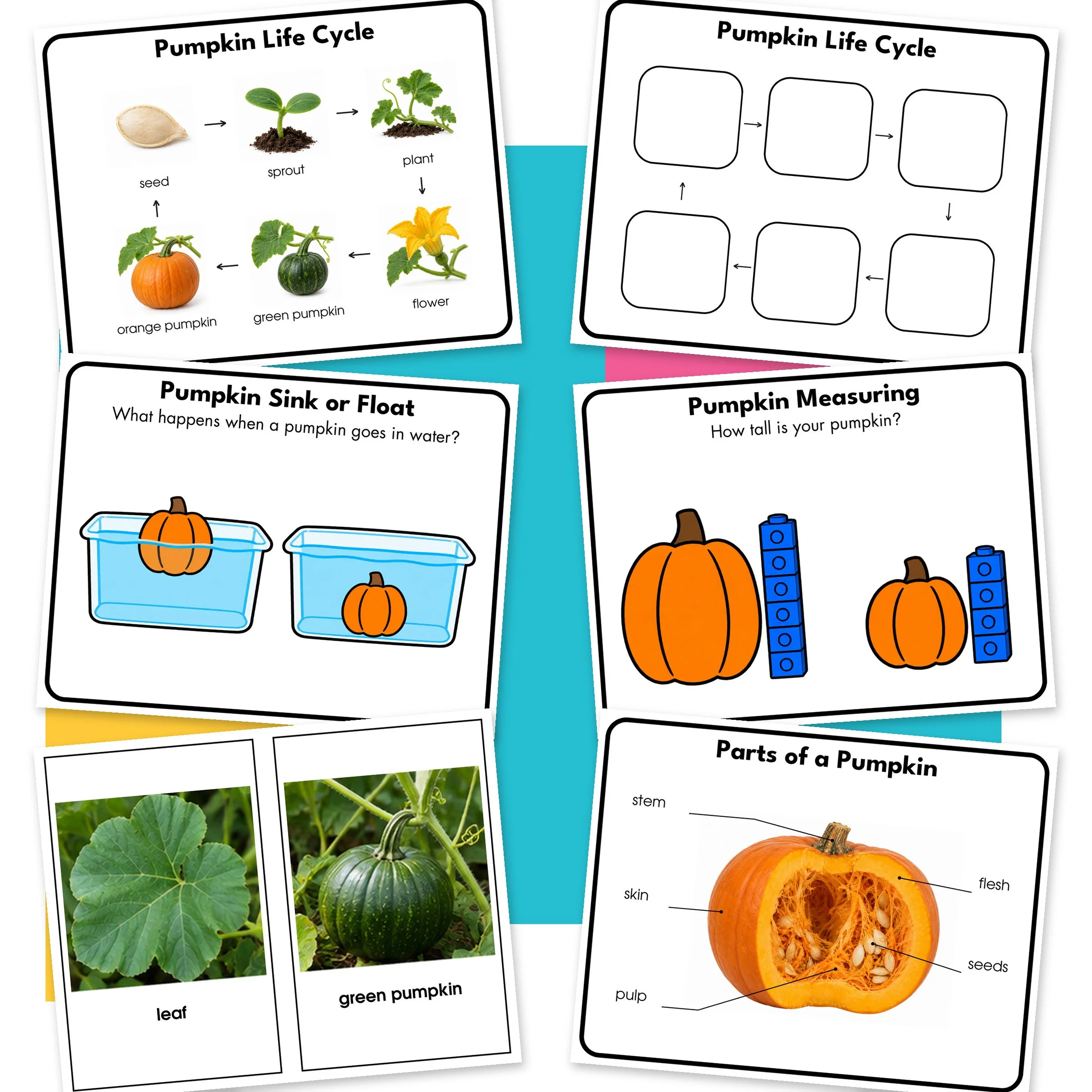
Children can investigate whether pumpkins sink or float, compare pumpkin heights using connecting cubes, hammer golf tees into pumpkins, and scoop and examine what is inside. Picture references and activity signs support independence, while vocabulary cards help children name and describe what they notice.
This resource is designed for flexible exploration. Introduce the materials and model how to use them, then give children opportunities to return to the investigations during free-choice centers. Choose the activities that fit your space, materials, and students’ interests.
What’s Inside
This resource includes:
Pumpkin Investigation poster
Parts of a Pumpkin poster
Pumpkin Life Cycle poster
Pumpkin Life Cycle sequencing page and cut-apart cards
24 picture word cards in two sizes: four per page and two per page
Full-page and half-page activity signs for Sink or Float, Pumpkin Measuring, Pumpkin Hammering, and Scoop and Explore
Half-page Pumpkin Observation recording sheet
Teacher Guide with setup suggestions and guidance for each investigation
How to Use
Gather real pumpkins in different sizes, shapes, colors, and textures. Display the Pumpkin Investigation poster and introduce the question, “What do you notice about pumpkins?”
Place the reference posters near the investigation area. Display relevant word cards beside the materials, or laminate, hole punch, and attach them to a binder ring so children can flip through them as they explore.
Set up any combination of the four investigations:
Sink or Float: Provide pumpkins and a tub with enough water and space for them to float freely. Invite children to predict what will happen, test their ideas, and observe the results. Children can point to the pictures on the sign to show their predictions and what happened.
Pumpkin Measuring: Provide pumpkins and connecting cubes of the same size. Model building a cube tower beside a pumpkin, starting on the same surface and measuring to the top of the pumpkin’s body. Children can compare pumpkins and their cube towers. Counting is optional, and written recording is not required.
Pumpkin Hammering: Provide a pumpkin, golf tees, and small mallets. Model holding a tee steady, tapping gently, and keeping fingers away from the striking area. Supervise as children practice controlling their tools.
Scoop and Explore: Have an adult cut open a pumpkin before offering it to children. Provide scoops, spoons, and a tray or bowl for collecting pulp and seeds. Invite children to scoop, separate, touch, and examine what they find.
Use the Pumpkin Life Cycle poster and sequencing materials to explore how a pumpkin grows. Offer the observation sheet for children who want to draw what they see, accepting drawings, marks, and beginning writing. An adult can also record a child’s spoken observations.
Why It Works
Pumpkin Investigation connects early science skills to real materials children can touch, examine, and explore.
Returning to the same materials gives children opportunities to notice new details, compare discoveries, and test ideas. The visuals support independent exploration, while the word cards and teacher conversations help children describe their thinking.
This resource helps:
Build observation and descriptive language
Encourage predictions and hands-on testing
Support comparing and measuring with nonstandard units
Introduce pumpkin parts and the pumpkin life cycle
Strengthen tool use and fine motor control
Connect vocabulary to real objects and experiences
Encourage children to share discoveries through conversation and drawing
Support meaningful science exploration during free-choice centers
Perfect For
Preschool ages 3–5
Pre-K
Science centers
Free-choice centers
Pumpkin investigations
Fall exploration
Small group instruction
Sensory exploration
Early measurement
Prediction and observation
Fine motor activities
Plant life cycle exploration
Homeschool preschool
Preschool Vibes Standards
3C. We can use vocabulary to describe, explain, and share ideas.
5M. We can measure using nonstandard units when ready (blocks, cubes, hands, steps).
6A. We can observe using our senses and describe what we notice.
6C. We can make predictions about what might happen.
6D. We can test ideas and notice what happened.
6H. We can explore living things and what they need (plants, animals, habitats).
8D. We can use tools with increasing control (tweezers, scissors, markers, droppers, etc.).
Digital Download & Terms of Use
This is a digital download only. No physical product will be delivered.
Real pumpkins, connecting cubes, tubs, golf tees, mallets, scoops, and other investigation materials are not included.
This resource is for personal and single-classroom use only. You may not resell, redistribute, share, upload, or claim this file as your own.
Due to the digital nature of this product, all sales are final.