
Which Sandcastle Is Mine?
Which Sandcastle Is Mine?
Quick Answer
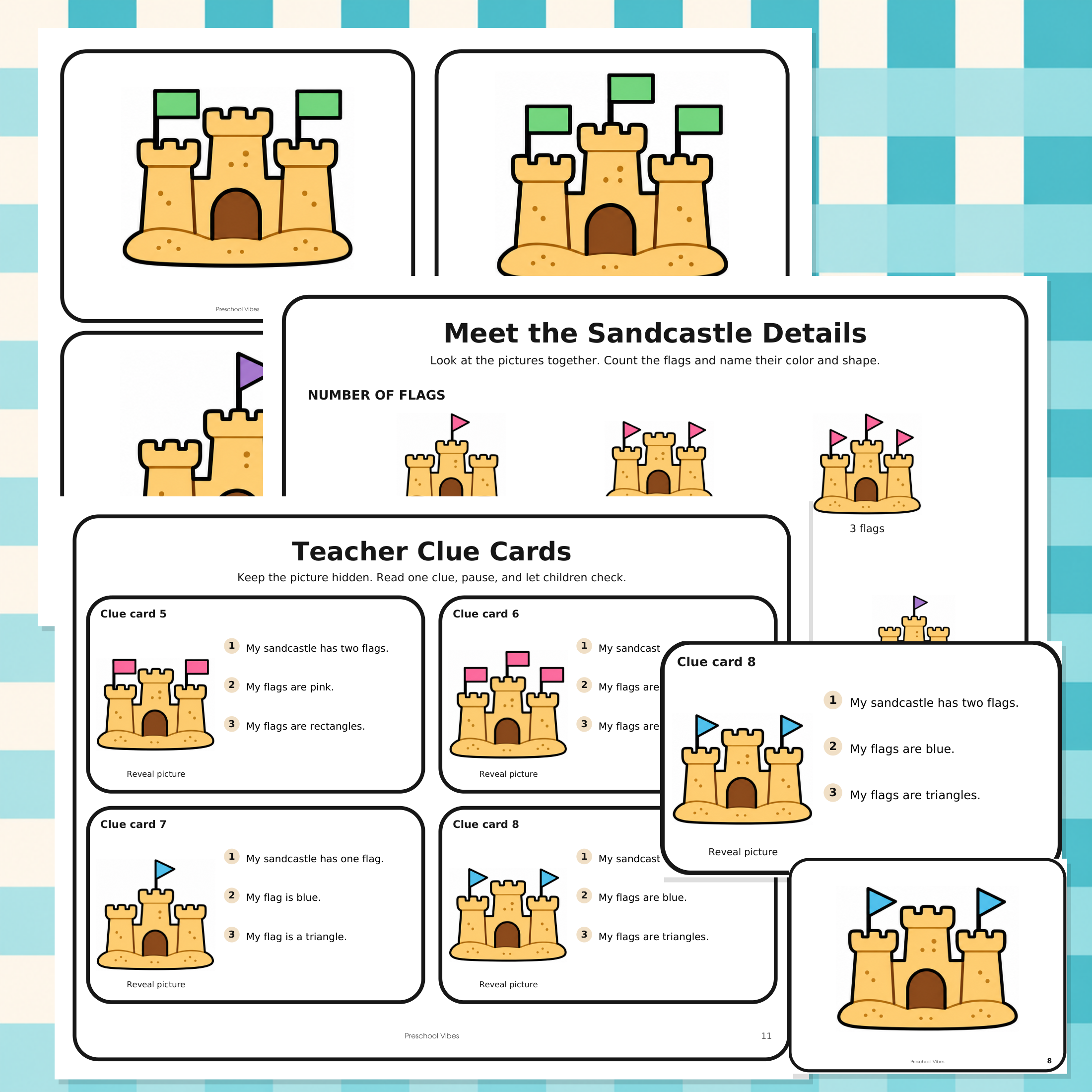
Which Sandcastle Is Mine? is a preschool listening game for calling children up and taking turns. Each child holds a different sandcastle card while you read three clues about the number of flags, flag color, and flag shape. The child whose sandcastle matches comes forward to collect an item or take a turn.
Use it during a beach or summer theme at large group time, when handing out project supplies, or when children are coming up to choose a classroom prop or collect a sticker.
What’s Included
This 16-page printable PDF includes:
24 sandcastle picture cards, four per page
24 matching teacher clue cards, four per page, with three numbered clues and a reveal picture
A picture key introducing flag counts, colors, and shapes
An overview showing all 24 sandcastles
A teacher guide with setup directions and a sample turn
The sandcastles have one, two, or three flags in pink, blue, green, or purple. The flags are triangles or rectangles. Each complete set of three clues matches exactly one card.
How to Use
Print in color at 100% or actual size. Cut apart the cards and laminate if desired. Introduce the colors and shapes with the picture key, then practice counting only the flags.
Give each child a different picture card and keep the matching clue cards with you. Hide the reveal picture and read the clues in order, pausing after each one. Children check their pictures and wait until all three clues match.
The matching child brings you their card, then collects their item or takes their turn. Set both cards aside and continue until everyone has been called. For a smaller group, use fewer picture cards and their matching clues.
Why It Works
Children have a picture to check as they listen. Each clue helps them narrow down the match while practicing counting, color and shape vocabulary, attention, and waiting for their turn.
Preschool Vibes Standards
1C. We can pay attention and use self-control with support (wait, stop, start, safe body).
3A. We can listen and respond during group times, stories, and conversations.
3C. We can use vocabulary to describe, explain, and share ideas.
5B. We can count objects with one-to-one correspondence.
5C. We can understand that the last number we say tells “how many.”
5E. We can recognize small quantities without counting (as appropriate).
Digital Download
This is a printable PDF resource. No physical product will be shipped.