
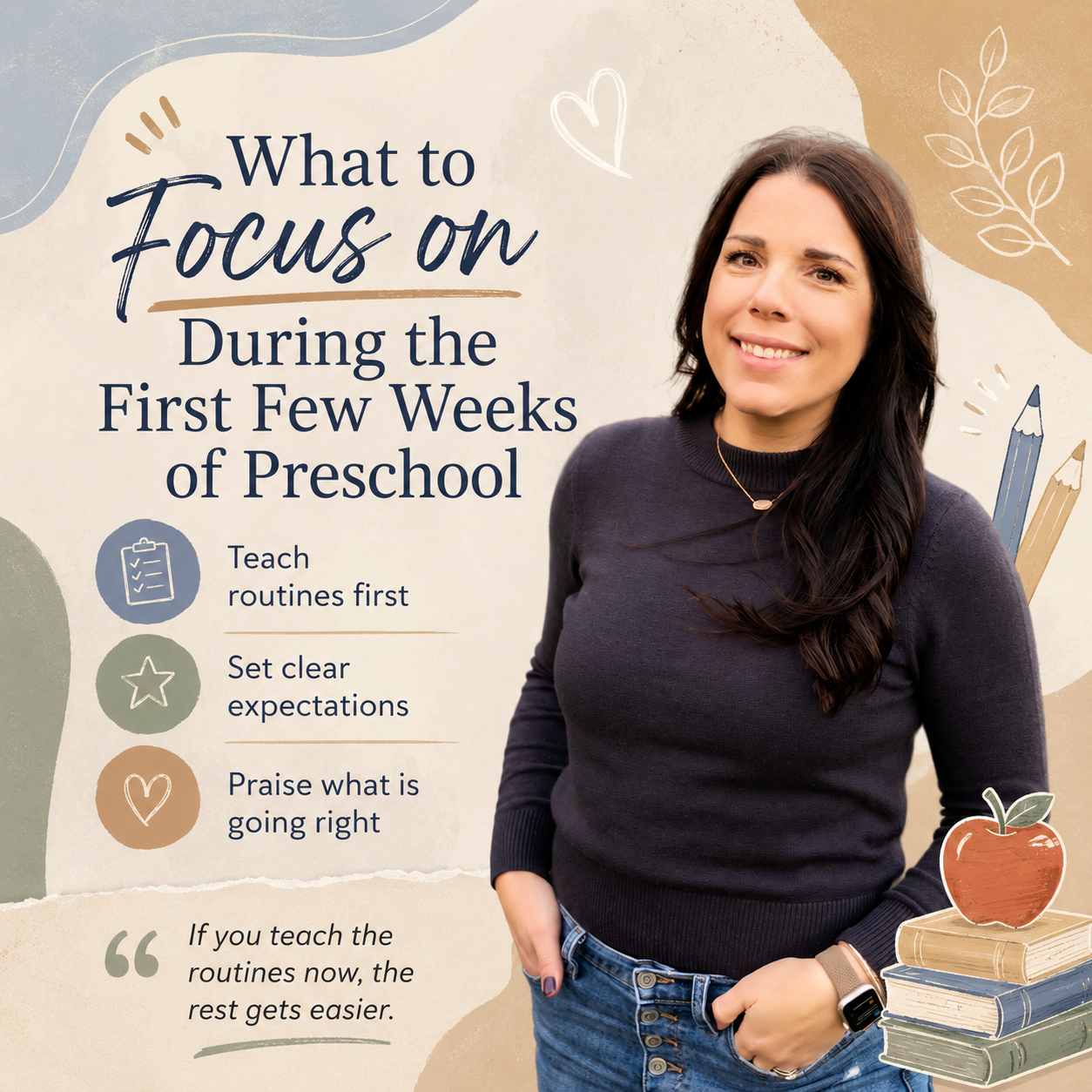
What to Focus on During the First Few Weeks of Preschool
After 17 years of teaching preschool, I can tell you this: the first day of school is still one of the hardest days of the entire year.
You leave exhausted. You might be sweaty. You might even wonder how in the world this classroom is ever going to run smoothly.
And then the next day is a little better.
And the next one gets a little easier.
Within a few weeks, the same children who needed help with absolutely everything are walking in, hanging up their backpacks, answering the question of the day, joining table time, lining up, cleaning up centers, and moving through the classroom like they have been doing it forever.
But that doesn't happen by accident.
The biggest thing I have learned is that the beginning of the year is not the time to rush into academics.
It is the time to teach children how to be successful in your classroom.
Don't Rush Into the Lessons
One of the biggest mistakes I see at the beginning of the year is teachers feeling like they need to immediately start teaching all of the academic content they have planned.
You don't.
I would much rather spend the first two to four weeks teaching routines, expectations, classroom rules, problem solving, friendship skills, independence, and how our classroom works.
Those first few weeks front-load the rest of your year.
There will be plenty of time for letters, numbers, and all of the other academic skills you want to teach.
When I do start introducing more academic skills, I start simple. We work on colors and shapes. We learn about the five senses. We practice pre-writing skills, how to hold a marker or crayon, and how to make different types of lines.
I usually don't even begin really focusing on letters until around week six or seven.
Before I can teach children the academics, I need them to know how to learn in our classroom.
Relationships Come First, But So Do Expectations
You've probably heard a million times that relationships are the most important part of teaching preschool.
I completely agree.
Some of these children are away from their parents for the first time. They need to know that I am their teacher, I care about them, and I am there to help them.
I actually take pictures of my students at open house and study them before the first day so I already know everyone's name when they walk through the door.
That little thing immediately helps build a connection.
But there's another side of relationships that I don't think we talk about enough.
Your students need a teacher, not another friend.
You can have an amazing relationship with your students while also having very clear expectations for them. In fact, I think those two things work best together.
Preschoolers are capable of following classroom expectations.
That doesn't mean they will know them on Day 1. It means we have to teach them, practice them, and consistently hold them to them.
Teach Every Routine
We sometimes forget how many things happen during a preschool day that are completely new to a child.
On the first day, I am teaching things as basic as:
Where do I put my backpack?
Where is the bathroom?
What happens when I come into the classroom?
Where do I sit at carpet time?
How do we line up?
What do I do when I'm finished playing at a center?
What can I use in the classroom?
How do we clean up?
Our schedule stays consistent, so I begin teaching that routine right away.
Children learn that they will come in, hang up their backpacks, answer the question of the day, and go to table time. Then we move to carpet time, and I teach them what carpet time looks like too.
I model everything.
If we're learning how to line up, I show them exactly what I mean. Stand behind your friend. You should be able to see the back of their head. Then we practice walking around the classroom together in a line.
And if we're heading outside and the line completely falls apart, we stop and try again.
The same thing happens with every routine.
We model it. We practice it. We use visuals. We repeat it.
You're not wasting teaching time when you do this.
You are creating the teaching time you'll have later.
Praise, Praise, Praise
During those first few weeks, I am constantly looking for children doing the right thing.
If I'm trying to teach carpet expectations, I'm noticing the children who are sitting and listening.
If we're lining up, I'm pointing out the children who are standing safely behind their friends.
If we're cleaning centers, I'm noticing the children putting materials back where they belong.
I want children to hear what they're doing right.
In my classroom, I also use a star chart. Students can move up the chart, but they don't move backward. When they reach the top, they choose a mini eraser and start again.
It gives me another simple way to constantly reinforce the behaviors I want to see.
For me, so much of behavior management comes back to three things:
Build the relationship. Set clear expectations. Praise children when they meet them.
Some Beginning-of-Year Behaviors Are Completely Normal
The beginning of preschool can feel a little wild.
Children might cry when their parents leave.
They might tell you no.
They might get up during carpet time and try to go play.
They might dump an entire bin onto the floor.
They aren't necessarily trying to make your day difficult. They're bringing whatever routines and expectations they've learned at home into a completely new environment.
Your job is to calmly show them that preschool works a little differently.
If a child wants to leave carpet and play at centers, for example, playing at centers isn't going to become the alternative to carpet time. I may have my assistant stand in front of the child and calmly remind the child that right now we are at the carpet.
I'm not going to pick them up and force them onto the rug.
But I'm also not going to make leaving the group more fun than following the classroom expectation.
They learn very quickly when expectations are clear and consistent.
Drop-off can be another hard one. When children are crying, I usually encourage parents to give one big hug, say goodbye, and leave confidently.
Lingering often makes the separation harder.
Most children settle in once their parent is gone and they have a chance to become involved in the classroom.
You Don't Have to Close Every Center
Another common recommendation is to only open a couple of centers at the beginning of the year.
That's never been how I run my classroom.
I've always used free-choice centers, and with a classroom full of preschoolers, they need choices.
I typically have almost all of my centers available from the first day.
The difference is that I keep the materials simple.
I teach the most important expectations first:
We don't dump bins.
Sensory materials stay in the sensory table, not on the floor, on our bodies, or on our heads.
We share materials.
When you're finished at a center, you clean it up before moving somewhere else.
I don't try to explain every detail about every center before children are allowed to play. They couldn't possibly remember all of that anyway.
Instead, during the first couple of weeks, my assistant and I spend center time walking around the classroom, observing, helping, and teaching expectations as children use the space.
Later in the year, I might be leading small groups while my assistant works on an art activity.
At the beginning, teaching children how to use the classroom is the small-group lesson.
The one center I usually wait to open is the painting easel. I'll introduce that on Day 2 or 3 after I've had a chance to explain how we use it.
Set Up the Classroom for Independence
Your classroom environment can make your job much easier or much harder.
I want to be able to see every child in the room.
I also don't want one giant open space where preschoolers can run from one side of the classroom to the other. Furniture can help create natural boundaries between centers.
A shelving unit can define the block area.
A table can define the writing center.
I also try to keep quieter centers away from our loudest areas.
And one of my biggest rules for classroom setup is simple:
If children aren't allowed to use it, don't put it where they can reach it.
If something is accessible to my students, I want them to be able to use it independently.
At the beginning of the year, that also means keeping materials very simple.
I don't immediately put out scissors, glue, or other materials that we haven't discussed yet. We introduce them, practice how to use them, and then they become part of the classroom.
The goal is to create an environment where children can become increasingly independent instead of constantly needing an adult to tell them what they can and cannot touch.
Keep Large Group Short and Useful
There is so much to teach at the beginning of the year, but preschoolers can only sit for so long.
Our first large-group times are short, fun, and very intentional.
We might read a fun book.
We might sing a song.
Then I choose two or three things children actually need to learn about our classroom.
Maybe we're talking about the block center that day.
Maybe we're learning how to use a classroom material.
Sometimes we'll physically walk over to a center during large group and talk about it together.
You don't have to teach the entire classroom on the first morning.
You'll have tomorrow.
Prepare What You Can Ahead of Time
The first few weeks take a lot of energy, so anything you can prepare before children arrive is worth doing.
I like to have my centers set up with simple materials and print the first few weeks of anything I know I'll need.
That might include name papers, early lessons, or simple activities like our "Just a Dot, Not a Lot" glue practice.
Then I'm not trying to print tomorrow's activity after an exhausting first day.
The more little decisions I can remove from those first few weeks, the more energy I have for the children.
And If Your First Week Feels Like a Disaster...
It probably isn't.
I have been doing this for 17 years, and the first day is still hard.
There are new children who don't know you.
They don't know each other.
They don't know the classroom.
They don't know the schedule.
They don't know your expectations.
Of course it's going to feel different from the classroom you remember at the end of last year.
Those children had months of practice.
These children are just beginning.
So don't look at your first week and decide what your entire year is going to be like.
Keep building relationships.
Keep communicating your expectations clearly.
Hold your students to those expectations.
Notice and praise what they're doing right.
Practice the routines again tomorrow.
And remember:
If you teach the routines now, the rest gets easier.