
Space Investigation
Space Investigation
Quick Answer
Space Investigation is a 25-page preschool science resource with six hands-on activities, 12 realistic picture word cards in two sizes, reference pages, observation sheets, and a teacher’s guide. Children explore model craters, light and shadows, day and night, building, and design.
Video
[Add video link]
What's Inside
Space Investigation display
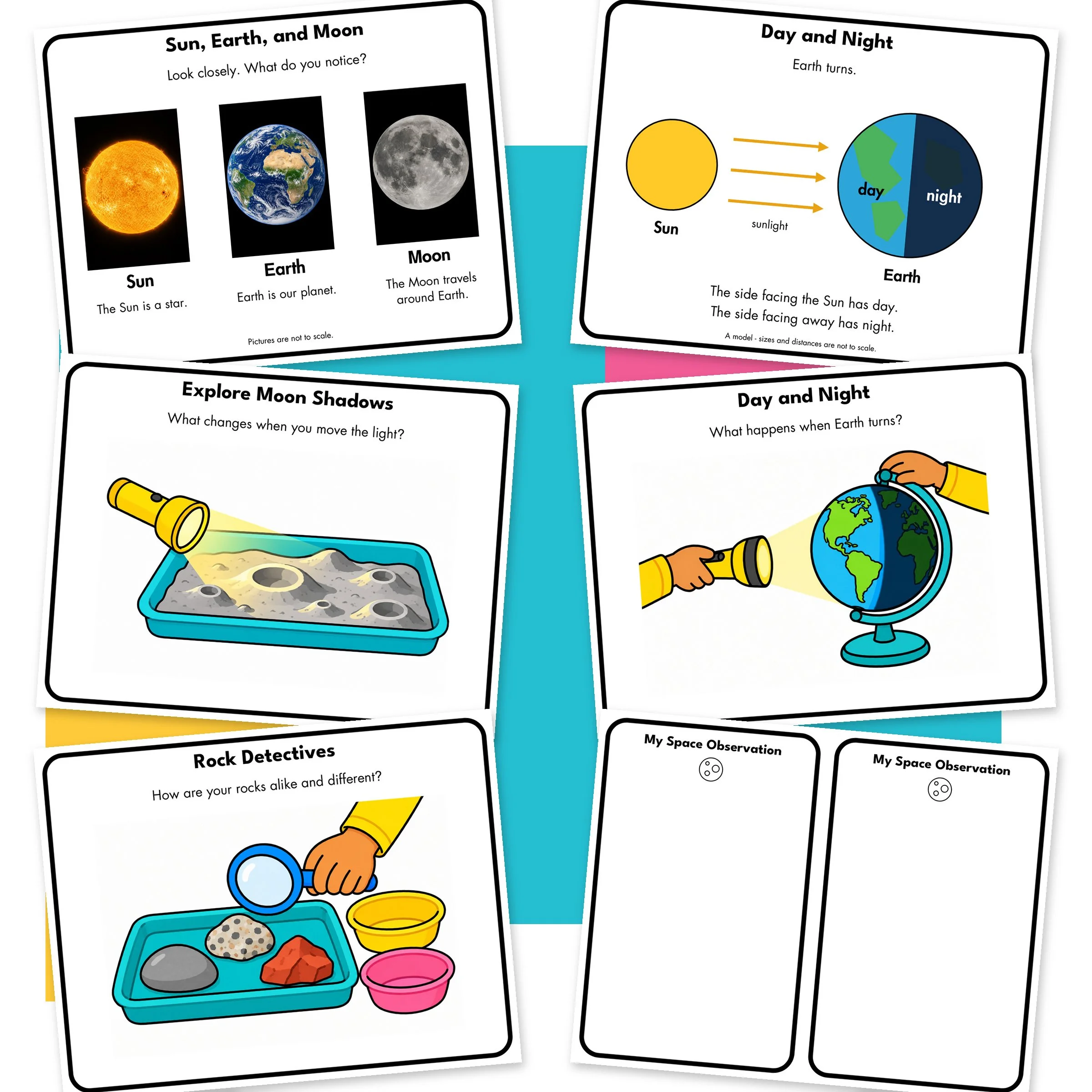
Sun, Earth, and Moon reference page
Day and Night reference page
Look at the Moon reference page
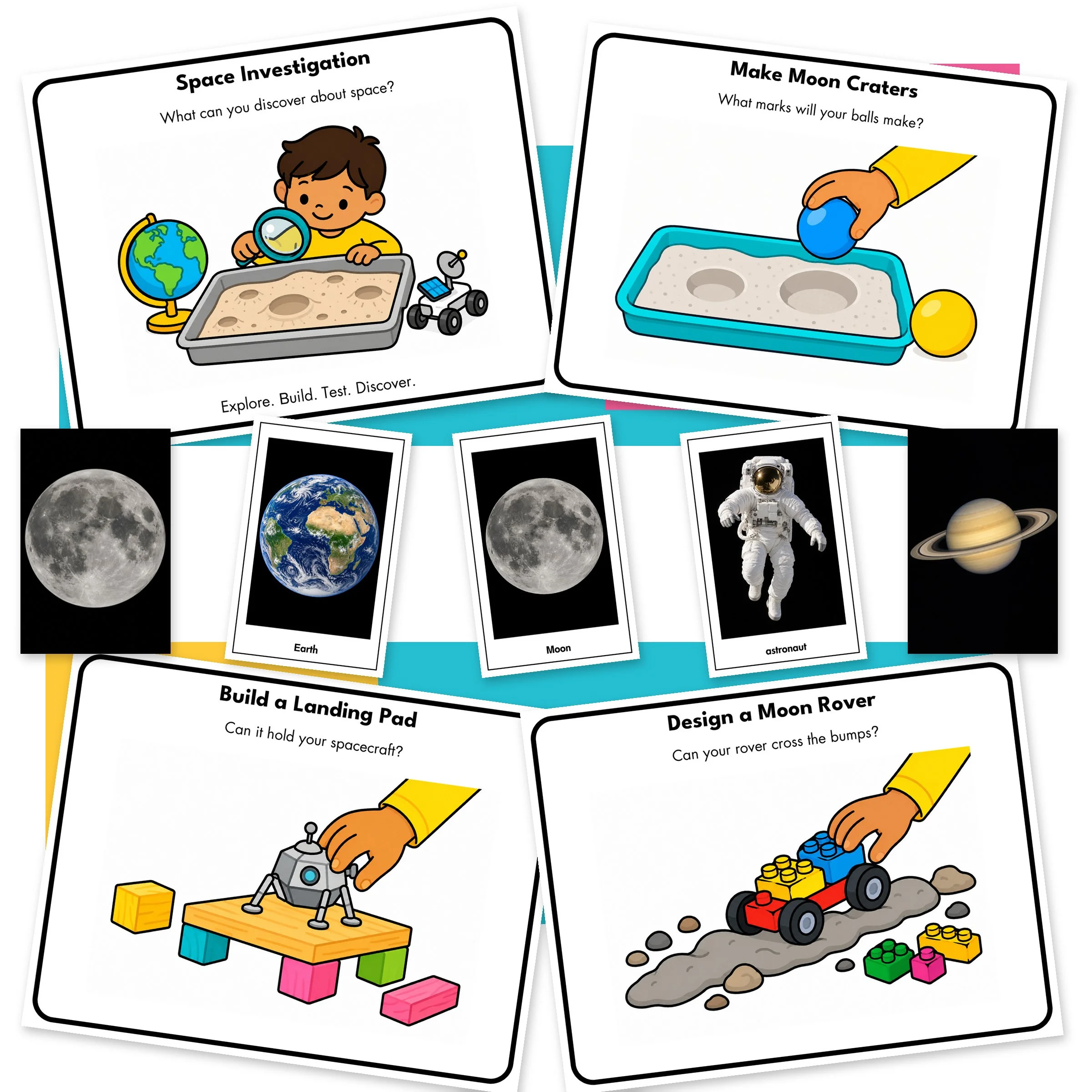
Six full-page activity signs
The same six activities in half-page format with no repeated signs
12 realistic picture word cards in four-per-page and two-per-page formats
Two identical half-page My Space Observation sheets
Teacher’s guide with materials, prompts, and explanations of classroom models
Activities
Make Moon Craters — What marks will your balls make?
Explore Moon Shadows — What changes when you move the light?
Day and Night — What happens when Earth turns?
Build a Landing Pad — Can it hold your spacecraft?
Design a Moon Rover — Can your rover cross the bumps?
Rock Detectives — How are your rocks alike and different?
Picture Word Cards
Sun, Earth, Moon, stars, astronaut, rocket, rover, crater, satellite, Mars, Saturn, telescope.
How to Use
Choose one or two investigations at a time and set out the matching sign. Use a shallow tray of sand and large balls to make craters, then explore the surface with a flashlight. Use a stationary flashlight and a turning globe for an adult-led day-and-night demonstration. Build a landing pad from blocks, design a rover with wheeled construction pieces, and compare ordinary Earth rocks with magnifiers.
Display reference pages beside the materials. Cut word cards into equal halves or quarters; the four-per-page cards turn upright after cutting. Use them as labels, matching cards, or a vocabulary ring. Children can draw discoveries on My Space Observation. Adult dictation is optional; independent writing is not required.
Why It Works
Children make predictions, test ideas, compare results, and adjust their designs. The activities connect concrete classroom experiences with early space vocabulary and give children repeated opportunities to describe what they notice.
Preschool Vibes Standards
6A. We can observe using our senses and describe what we notice.
6C. We can make predictions about what might happen.
6D. We can test ideas and notice what happened.
6E. We can use simple tools and materials to explore (magnifiers, droppers, ramps, magnets, balance, light).
6I. We can build and try solutions to simple problems (design/build/test/improve in play).
4H. We can use drawing and writing to share ideas, moving from scribbles and pictures to letter-like forms, letters, and name writing (as appropriate).
Teacher Notes
These activities use classroom models. Sand represents the Moon’s surface, a flashlight represents sunlight, and the classroom rock collection contains Earth rocks. Picture cards are realistic photo-style illustrations, not mission photographs. Pictures, diagrams, and models are not to scale. Use a flashlight for Sun models; never view the Sun through a telescope or magnifier.
Digital Download & Terms of Use
This is a digital download. No physical product will be shipped. Classroom materials are not included. No Canva account is required.
For personal and single-classroom use only. Do not resell, redistribute, share, upload, or claim this resource as your own. Due to the digital nature of this product, all sales are final.