
Bird Investigation
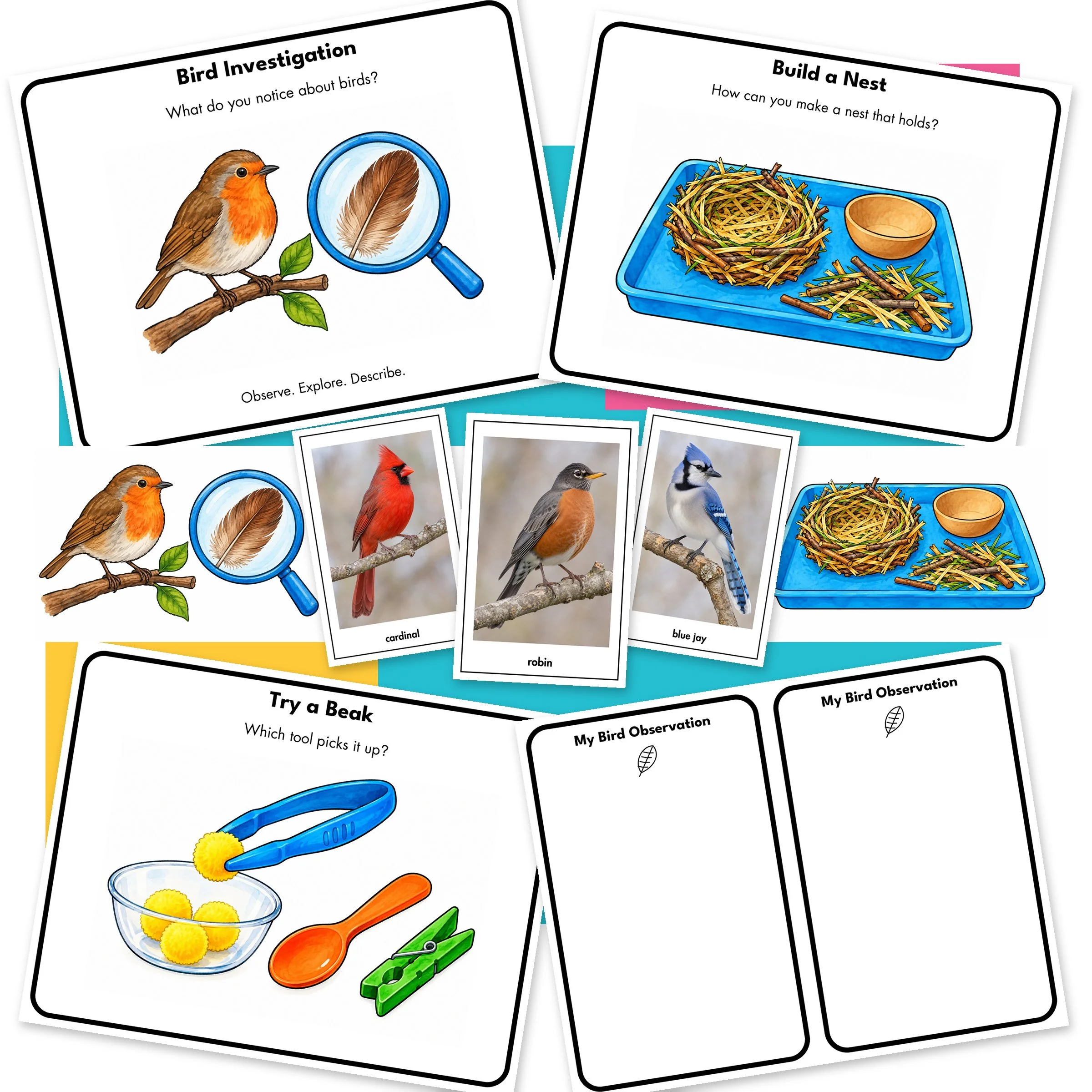
Bird Investigation
Quick Answer
Bird Investigation is a hands-on preschool science resource for exploring birds through observation, nest building, tool tests, tracks, and feathers in moving air. This 24-page printable set includes six illustrated activity signs in two sizes, 12 picture word cards in two sizes, bird reference pages, a half-page observation sheet, and a teacher’s guide with setup ideas.
Description
Bring the birds children notice outside into meaningful science-table exploration. Bird Investigation invites children to look closely at feathers, compare bird features, build pretend nests, test tools as beaks, and investigate the marks toy bird feet make.
Simple cartoon illustrations and short questions introduce each activity. Children explore with real materials, talk about their discoveries, and try new ideas without needing to complete written answers. The realistic picture word cards support vocabulary and conversations about birds, feathers, nests, and investigation tools.
Use the resource for science centers, small groups, spring themes, nature studies, or bird watching throughout the year. The activities work as separate invitations, so you can choose the setups that fit your space and materials.
What’s Inside
This resource includes:
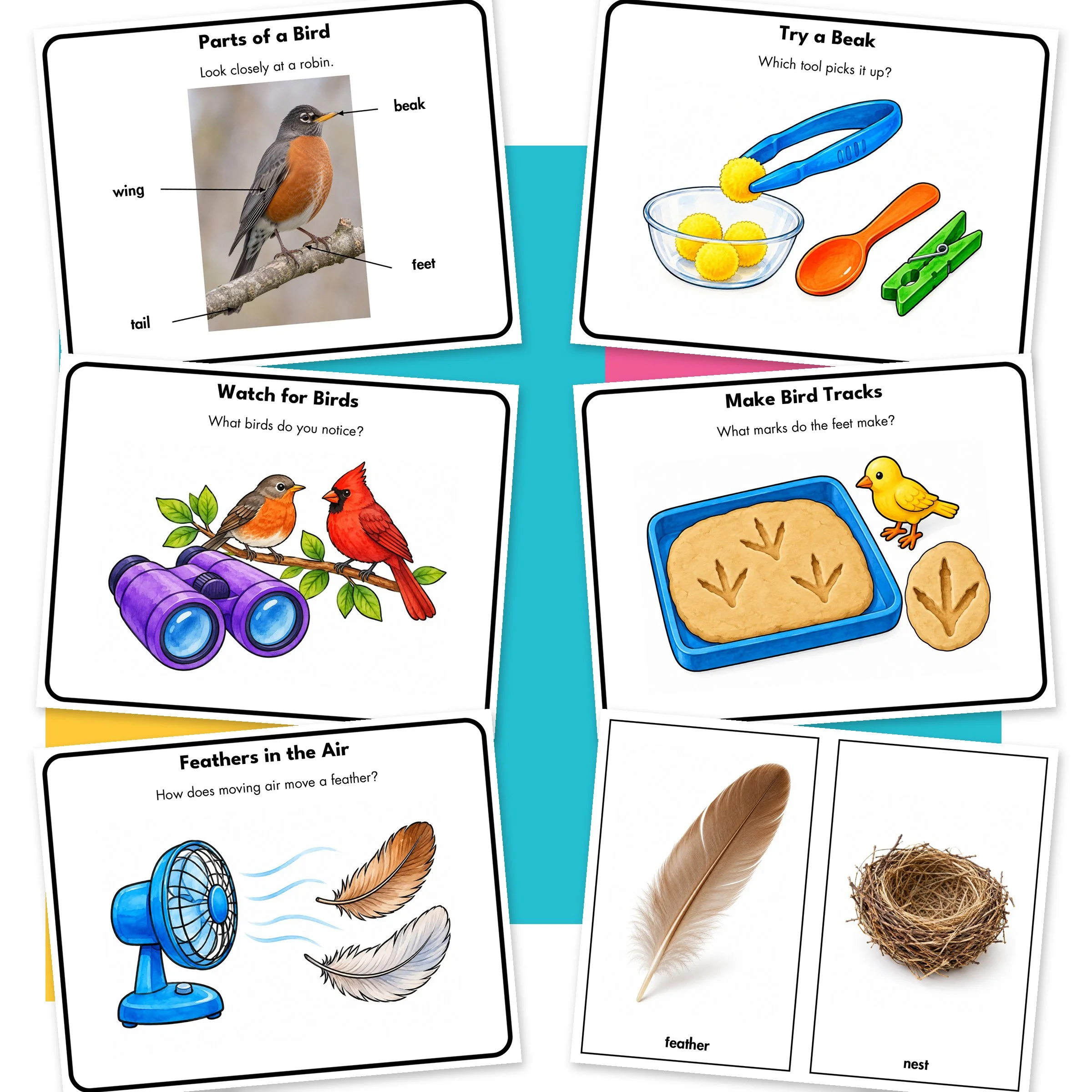
Bird Investigation display; Parts of a Bird and Compare Birds reference pages
12 picture word cards in four-per-page and two-per-page formats
Six full-page and half-page activity signs: Look at Feathers, Build a Nest, Try a Beak, Watch for Birds, Make Bird Tracks, and Feathers in the Air
Half-page My Bird Observation drawing sheets
Teacher's guide with setup ideas
The 12 picture word cards are robin, cardinal, blue jay, sparrow, duck, owl, feather, nest, egg, binoculars, tweezers, and magnifying glass.
How to Use
Choose one or two activity signs and prepare the matching materials. Full-page and half-page versions let you choose the display size that fits your tray or table.
For Look at Feathers, offer clean craft feathers and magnifiers. Children can compare edges, shapes, sizes, and textures. For Build a Nest, provide small bowls, short twigs, dry grass, and paper strips. Invite children to build, test whether their nest holds a model egg or ball, and make adjustments.
For Try a Beak, compare tweezers, a spoon, and a clothespin using the same pretend food items. For Make Bird Tracks, press toy bird feet into dough and compare the impressions with the feet that made them.
Watch for Birds can take place at a window or outdoors. Invite children to notice colors, movement, beaks, and tails. Binoculars are optional. For Feathers in the Air, use a guarded fan on low to compare how craft feathers move when the fan is off and on.
Display the word cards near the materials or put them on a ring. Cut the observation page in half so children can draw a bird, feather, nest, track, or test they noticed. Writing is optional, and an adult may record children’s words.
The teacher’s guide explains the difference between classroom models and real birds. Bird pictures are examples and are not shown to scale.
Why It Works
Bird Investigation connects observation of living things with activities children can repeat and adjust. Children have opportunities to:
Notice and describe details
Compare bird features and material properties
Use tools to explore and test ideas
Connect footprints with the shapes that made them
Build, test, and improve a simple structure
Share observations through drawing and conversation
Perfect For
Preschool
Pre-K
Bird and nature themes
Spring investigations
Science tables and centers
Small group exploration
Outdoor observation
Homeschool preschool
Preschool Vibes Standards
6A. We can observe using our senses and describe what we notice.
6D. We can test ideas and notice what happened.
6E. We can use simple tools and materials to explore (magnifiers, droppers, ramps, magnets, balance, light).
6F. We can compare and describe materials and their properties (hard/soft, heavy/light, float/sink, transparent/opaque).
6H. We can explore living things and what they need (plants, animals, habitats).
6I. We can build and try solutions to simple problems (design/build/test/improve in play).
Digital Download & Terms of Use
This is a digital download only. No physical product will be delivered.
This resource includes printable PDF pages. Investigation materials and tools shown in the activities are not included.
This resource is for personal and single-classroom use only. You may not resell, redistribute, share, upload, or claim this file as your own.
Due to the digital nature of this product, all sales are final.