
Bugs & Little Critters Investigation
Bugs & Little Critters Investigation
Quick Answer
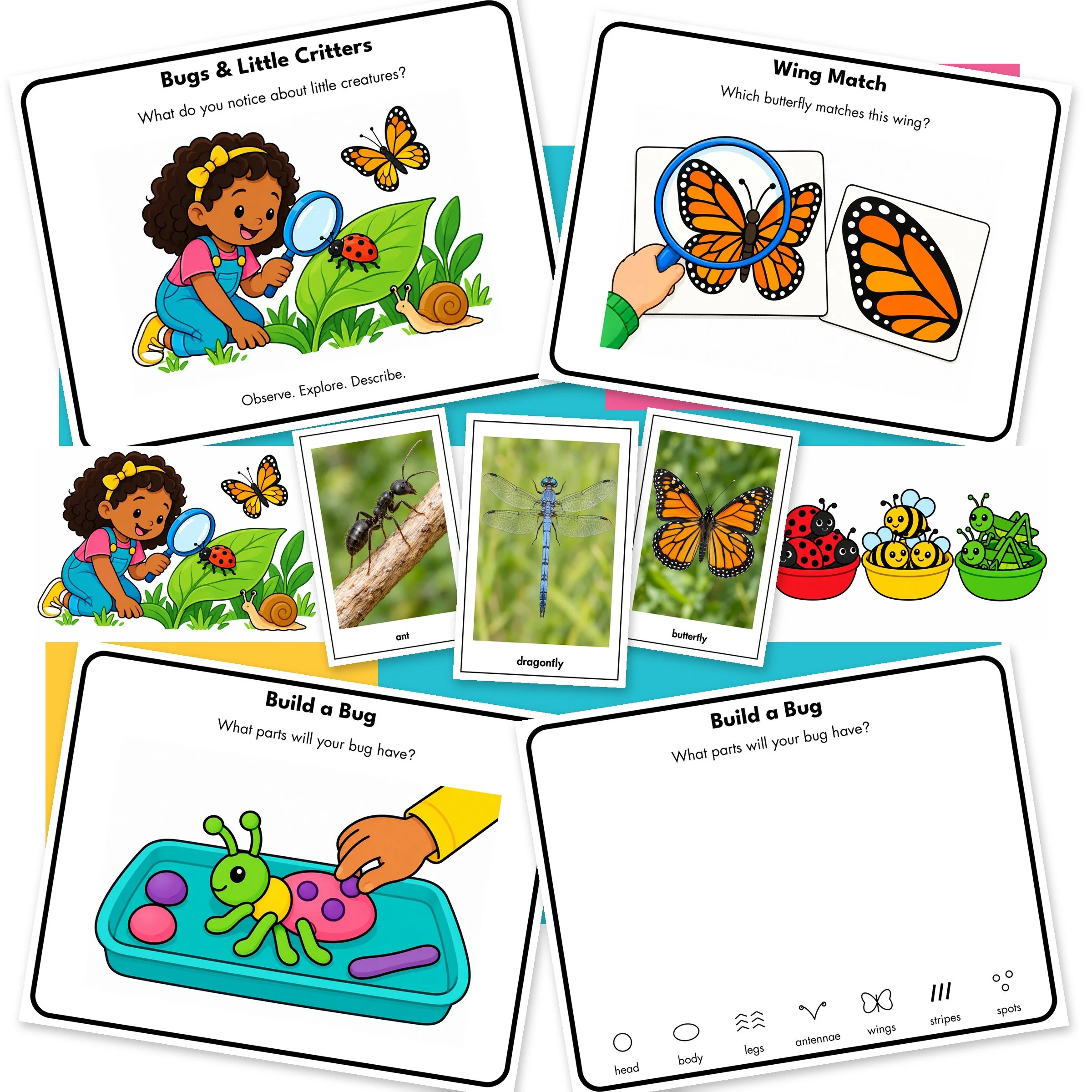
Bugs & Little Critters Investigation is a 37-page preschool science resource for observing small creatures, comparing body parts, exploring butterfly, ladybug, and bee life cycles, and matching butterfly wing patterns. It includes five activity signs in full-page and half-page formats, 12 realistic picture word cards in two sizes, labeled reference pages, a reusable life cycle activity, a teacher's guide, My Bug Observation drawing sheets, and Draw a Bug sheets with picture checkboxes.
Description
Turn children's interest in little creatures into hands-on science. This resource invites children to look closely, sort and compare, match wing patterns, make toy bug prints, and build their own Play-Doh bugs.
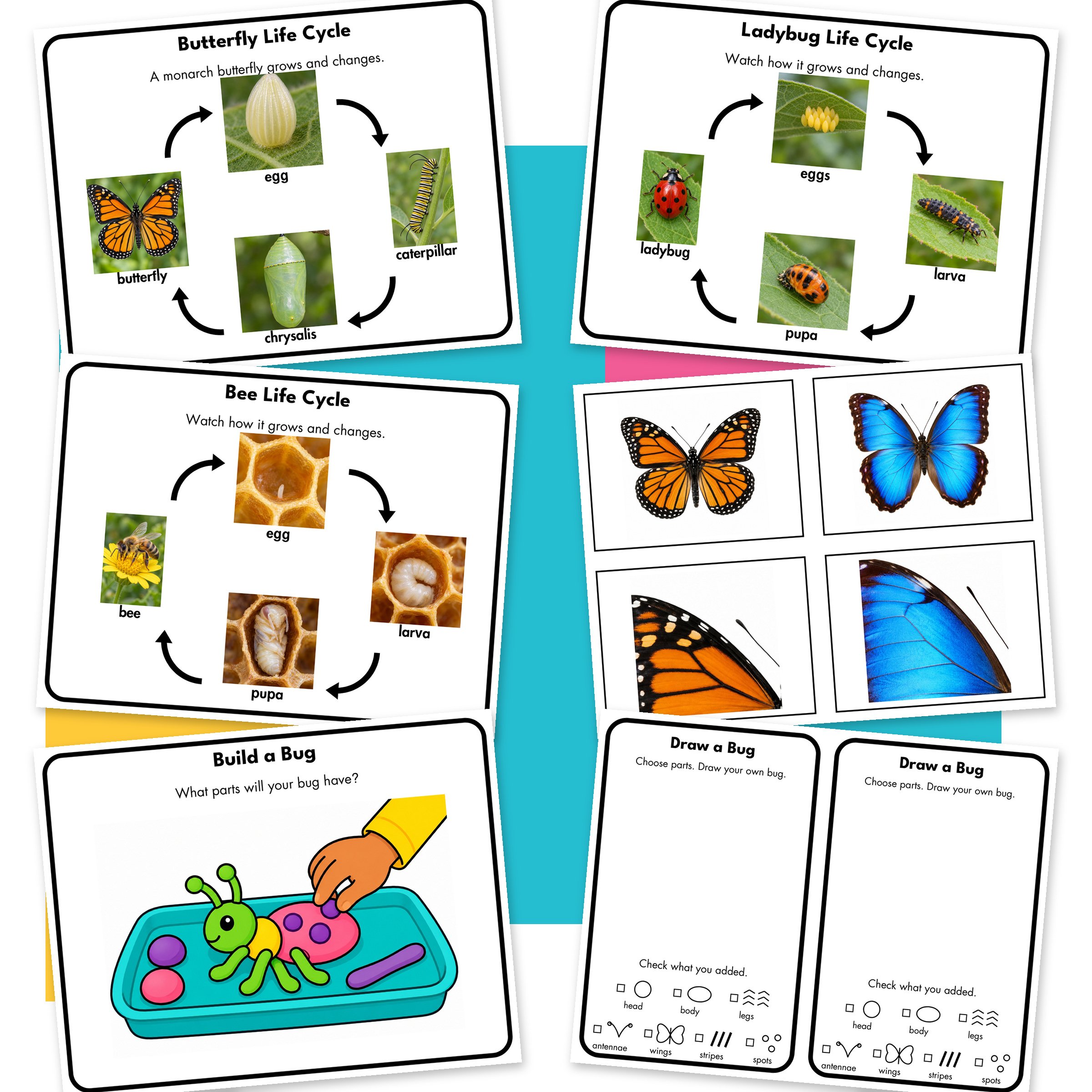
Simple cartoon activity signs guide classroom exploration, while realistic picture word cards build vocabulary and invite close observation. Reference pages show the parts of an insect and the differences between insects and spiders. Three insect life cycle posters, matching mats, and cut-apart stage cards give children reusable sequencing activities with realistic pictures.
Every table activity can use toys and pictures. Live creatures are not required. Children can also connect their discoveries with respectful outdoor observation.
What's Inside
Bugs & Little Critters investigation display
Parts of an Insect labeled ant diagram
Insects and Spiders comparison page
Butterfly, ladybug, and bee life cycle posters grouped in one section
Three matching circular sequencing mats
12 cut-apart stage cards sized to fit their mats
Six butterfly picture cards and six matching wing close-up cards, four cards per page
12 picture word cards in four-per-page and two-per-page formats
Five full-page activity signs
The same five activities in half-page format; the Build a Bug sign shares a sheet with a small building mat
Full-page Build a Bug Play-Doh mat with picture cues
Half-page My Bug Observation drawing sheets
Half-page Draw a Bug sheets with a picture menu and checkboxes
Teacher's guide with setup ideas
Activities include Look Closely, Sort and Compare, Wing Match, Bug Prints, and Build a Bug.
Word cards include ant, ladybug, bee, butterfly, caterpillar, grasshopper, dragonfly, spider, snail, earthworm, egg, and chrysalis.
How to Use
Choose one or two activities and gather toy creatures, magnifiers, trays, bowls, and Play-Doh as needed. Place the matching sign beside the materials.
Offer bowls for sorting and regrouping toy bugs. Use accurate adult insect and spider toys for counting legs. Press toys into dough to compare impressions. Pair each wing close-up with its matching butterfly picture. Begin with two pairs, then add more. Children use colors, spots, stripes, and wing edges to find each match.
Display the reference pages for discussion. The three insect life cycles are grouped together. Cut apart the life cycle stage cards and use them with their matching sequencing mats. Print the mat and cards at the same scale so they fit together. Laminate for repeated use if desired.
Use word cards to label materials, match toys, or make a flip ring. The four-per-page cards turn upright after cutting into equal quarters.
Offer My Bug Observation for drawing discoveries. An adult may record children's words; independent writing is optional. On Draw a Bug, children choose from a picture menu of a head, body, legs, antennae, wings, stripes, and spots. They draw their own bug and check what they added. This is an imaginative drawing activity; no number writing is needed. Laminate the full-page Build a Bug mat or place it in a dry-erase sleeve. Children roll and shape Play-Doh, using the picture cues to choose parts. Offer craft sticks or pipe cleaners as optional loose parts. They can draw their finished creation on Draw a Bug and check what they added. Classroom materials are not included.
Why It Works
Children can return to the same materials with a new question, grouping rule, or observation. The mix of pictures, models, and hands-on exploration gives them several ways to participate.
This resource helps children:
Observe and describe details
Compare body parts and recognize differences
Sort by shared attributes
Use simple tools to investigate
Match details to a whole picture
Compare wing colors and patterns
Sequence and compare three insect life cycles
Share discoveries through conversation and drawing
Perfect For
Preschool and Pre-K
Bugs, insects, and spring themes
Science tables and discovery centers
Small group investigations
Insect life cycle learning
Early STEM exploration
Observation and vocabulary activities
Homeschool preschool
Preschool Vibes Standards
6A. We can observe using our senses and describe what we notice.
6E. We can use simple tools and materials to explore (magnifiers, droppers, ramps, magnets, balance, light).
6H. We can explore living things and what they need (plants, animals, habitats).
3C. We can use vocabulary to describe, explain, and share ideas.
5K. We can sort objects by attributes (color, size, shape, type) and explain the rule.
4H. We can use drawing and writing to share ideas, moving from scribbles and pictures to letter-like forms, letters, and name writing (as appropriate).
Digital Download & Terms of Use
This is a digital download only. No physical product will be delivered.
The resource is a ready-to-print PDF. No Canva account is required. Toys and classroom materials are not included.
This resource is for personal and single-classroom use only. You may not resell, redistribute, share, upload, or claim this file as your own.
Due to the digital nature of this product, all sales are final.