
Learning About-Friendship
Learning About-Friendship
Learning About Friendship
Quick Answer
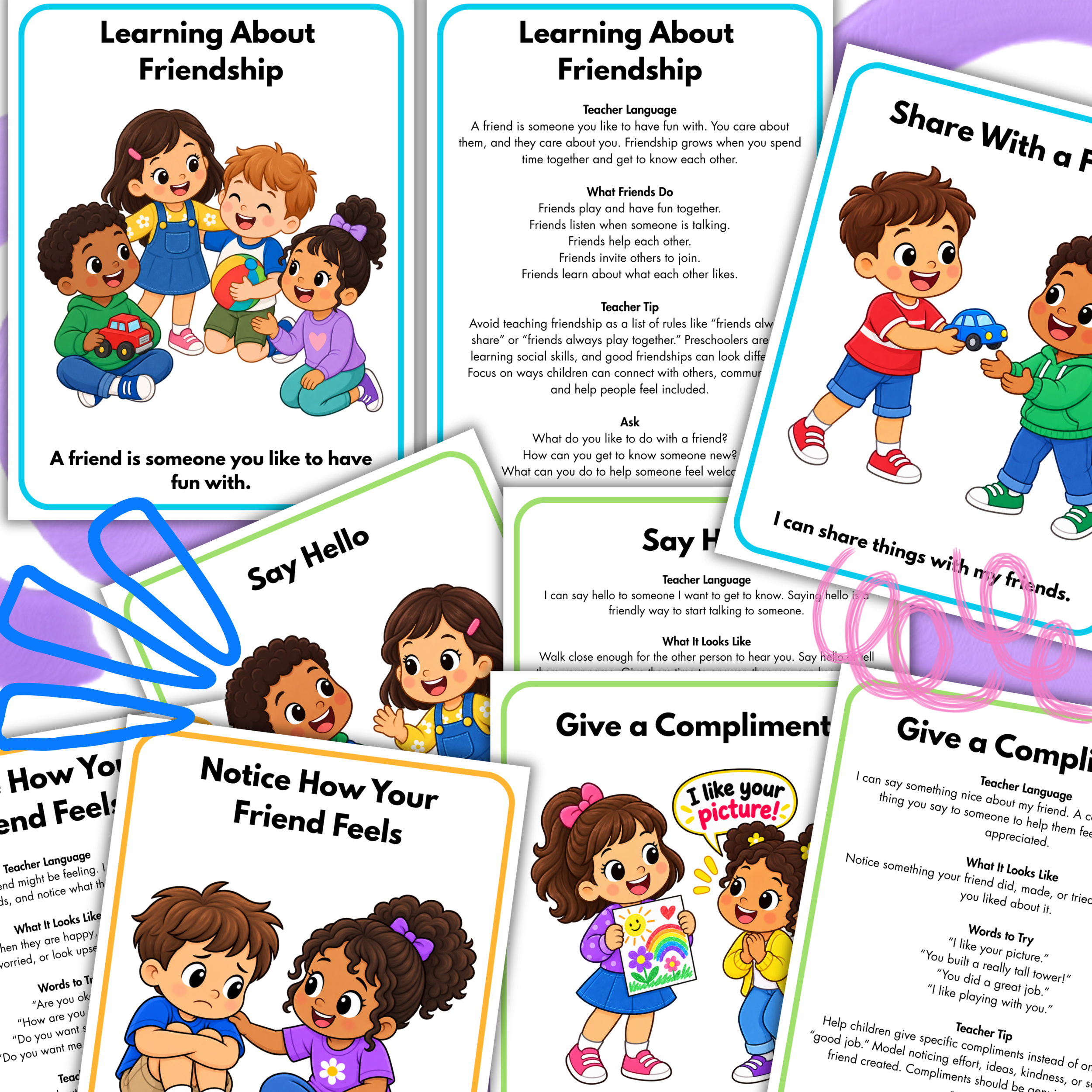
Learning About Friendship is a preschool social-emotional resource designed to help children understand what friendship looks like and practice the skills that help friendships begin and grow. Each friendship skill includes a child-facing visual page and a teacher-facing prompt page with simple language, real preschool examples, words children can try, teacher guidance, and discussion questions.
Description
Learning About Friendship is part of the Preschool Vibes Learning About series. This series is designed to introduce important early learning concepts through clear visuals, teacher-friendly language, and quick discussion prompts that can be used during large group, small group, morning meeting, classroom routines, or review.
This resource helps children learn how to connect with others, communicate during play, show kindness, notice how friends are feeling, and build positive relationships. Each friendship skill is introduced in a simple, child-friendly way so students can understand what the skill means and begin practicing it in real preschool situations.
Use Learning About Friendship at the beginning of the school year as children are getting to know one another, or revisit the cards throughout the year as new friendship situations come up during play, centers, group time, and classroom routines.
What’s Inside
This resource begins with an introduction to friendship, followed by cards that teach: Say Hello, Ask to Play, Invite Someone to Play, Learn About Your Friend, Listen to Your Friend, Help a Friend, Give a Compliment, Cheer for a Friend, Notice How Your Friend Feels, Share Your Ideas, Friends Can Like Different Things, Share With a Friend, Show Kindness, Be a Good Sport, and Say Thank You.
Each friendship skill includes two teaching pages:
Child-Facing Page
Each child-facing page includes:
Friendship skill
Large visual
Simple sentence children can understand and remember
Teacher-Facing Page
Each teacher-facing page includes:
Teacher Language
What It Looks Like
Words to Try
Teacher Tip
Ask
How to Use
Use these cards during large group, small group, morning meeting, social-emotional lessons, classroom routines, or anytime you are introducing and reinforcing friendship skills.
Show the child-facing page first so children can see the friendship skill, look at the visual, and hear a simple sentence connected to the skill.
Then use the teacher-facing page to explain the skill, model useful words and actions, give real preschool examples, and guide a short discussion.
You can use one card at a time for focused instruction, revisit cards when friendship situations come up, or keep the pages near your large group area, calm-down space, social-emotional materials, or classroom community display for quick review.
Pages can be displayed together or printed back to back for easy teacher-led instruction.
Why It Works
Learning About Friendship helps children understand friendship skills before they are expected to use them independently in social situations.
Instead of only reminding children after a problem happens, this resource gives you a clear way to teach what friendship can look like, what children can say, and how they can respond to others with kindness and care.
This resource helps:
Build friendship and social language
Help children learn how to begin and grow friendships
Provide simple words children can use during real social situations
Support listening, communication, empathy, kindness, and cooperative play
Help children understand that friends can enjoy different things
Connect friendship skills to familiar preschool situations
Give teachers practical language and prompts without a scripted lesson
Perfect For
Preschool
Pre-K
Kindergarten readiness
Friendship lessons
Social-emotional learning
Beginning-of-the-year routines
Morning meeting
Large and small group instruction
Classroom community
Cooperative play
Kindness lessons
Conflict prevention
Social language practice
Homeschool preschool
Preschool Vibes Standards
2D. We can play with others by taking turns and sharing space.
2E. We can build relationships through cooperative play (roles, teamwork, group goals).
2F. We can notice others’ feelings and respond with care.
3B. We can take turns in conversations and stay on topic with support.
3G. We can use language during play to negotiate roles, solve problems, and collaborate.
Digital Download & Terms of Use
This is a digital download only. No physical product will be delivered.
This resource is for personal and single-classroom use only. You may not resell, redistribute, share, upload, or claim this file as your own.
Due to the digital nature of this product, all sales are final.